What is Systemic Nickel Allergy?
What Is Systemic Nickel Allergy? The Hidden Condition Behind Your Mysterious Symptoms
If you've been struggling with unexplained digestive issues, stubborn skin problems, or crushing fatigue — and no one can figure out why — I need to tell you about a condition that affects millions of people and almost nobody is testing for.
It's called Systemic Nickel Allergy Syndrome (SNAS), and it might be the answer you've been searching for.
The Numbers That Should Alarm You
Nickel allergy is the most common contact allergy in the industrialized world, affecting roughly 10% to 20% of the population — and women are affected 4 to 10 times more often than men (Ahlström et al., 2019).
But here's what most people don't know: nickel allergy isn't just about jewelry rashes. Research shows that nearly 40% of patients with Gastroesophageal Reflux Disease (GERD) and up to 30% of patients diagnosed with Irritable Bowel Syndrome (IBS) test positive for a nickel allergy (Stanghellini et al., 2016; Rizzi et al., 2017).
And if you're a woman dealing with endometriosis alongside GI symptoms? Over 90% tested positive for nickel-related mucosal inflammation in one pilot study (Borghini et al., 2020).
Contact Allergy vs. Systemic Allergy: Two Very Different Problems
Most people — including many doctors — think of nickel allergy as a skin rash from cheap earrings or belt buckles. That's Allergic Contact Dermatitis (ACD), a localized Type IV delayed hypersensitivity reaction that only affects the skin where metal touches it.
Systemic Nickel Allergy Syndrome is something entirely different.
When a nickel-sensitive person eats nickel — which is naturally present in many foods, water, and supplements — the ingested nickel ions bind directly to immune sensors in the gut called Toll-like Receptor 4 (TLR4). This activates mast cells and triggers a body-wide inflammatory response that can affect your digestive system, your skin, your brain, and your joints (Di Tola et al., 2014).
It's not localized. It's systemic. And it's coming from the inside.
Symptoms by Body System
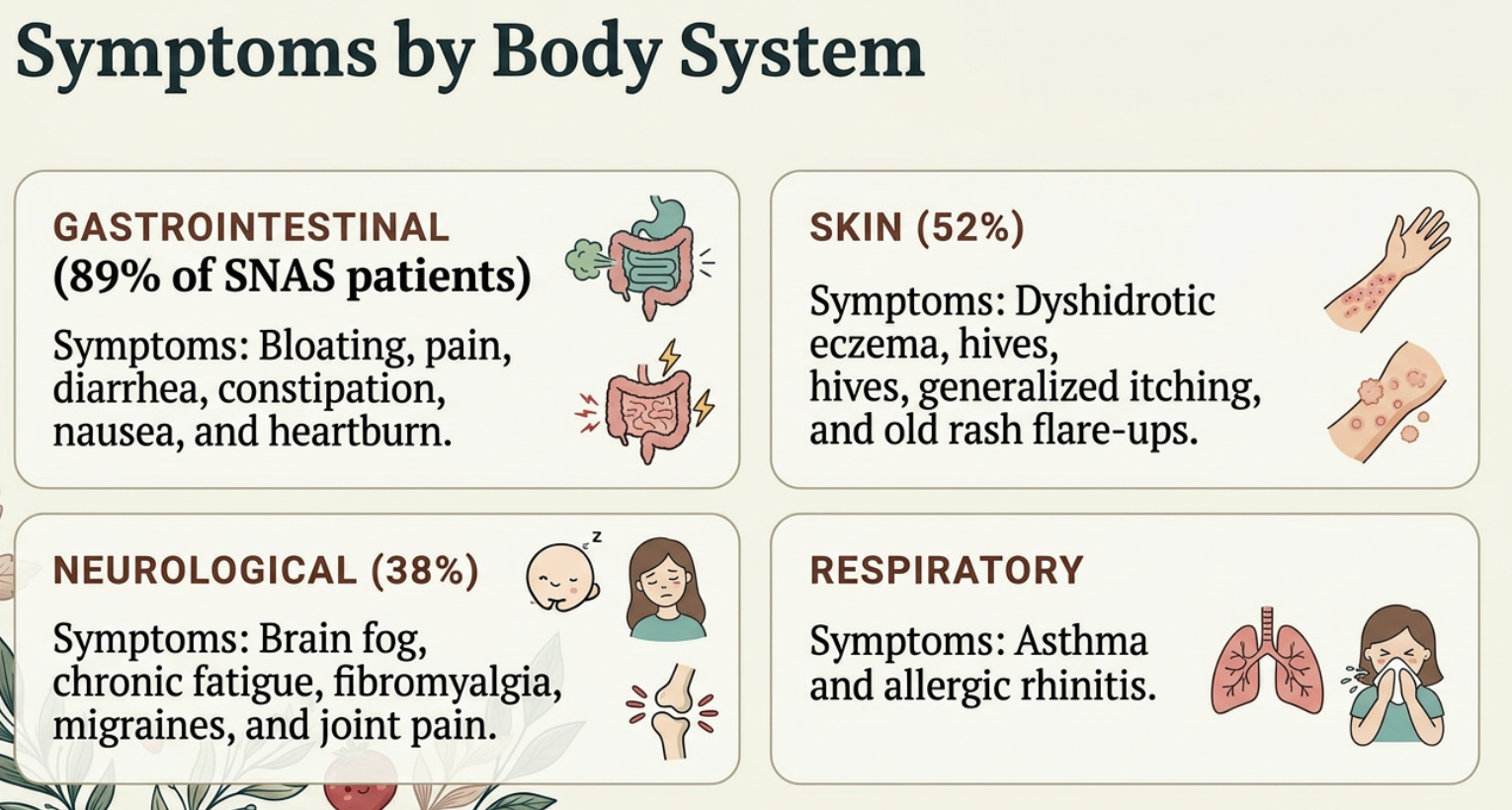
Symptoms of systemic nickel allergy include IBS, GERD, dyshidrotic hand and foot eczema, etc
In an epidemiological study of SNAS patients, symptoms broke down across multiple organ systems (Ricciardi et al., 2014):
Gastrointestinal (89% of patients): Bloating, abdominal pain, diarrhea, constipation, nausea, and severe heartburn.
Skin (52% of patients): Dyshidrotic eczema (intensely itchy blisters on the palms and soles), generalized itching, hives, and flare-ups of old rashes.
Neurological and general (38% of patients): Brain fog, chronic fatigue, fibromyalgia, joint pain, and migraines.
Respiratory: Asthma and allergic rhinitis.
If you're reading this list and checking off multiple boxes across different body systems — that pattern is exactly what SNAS looks like.
Why Standard Testing Misses It
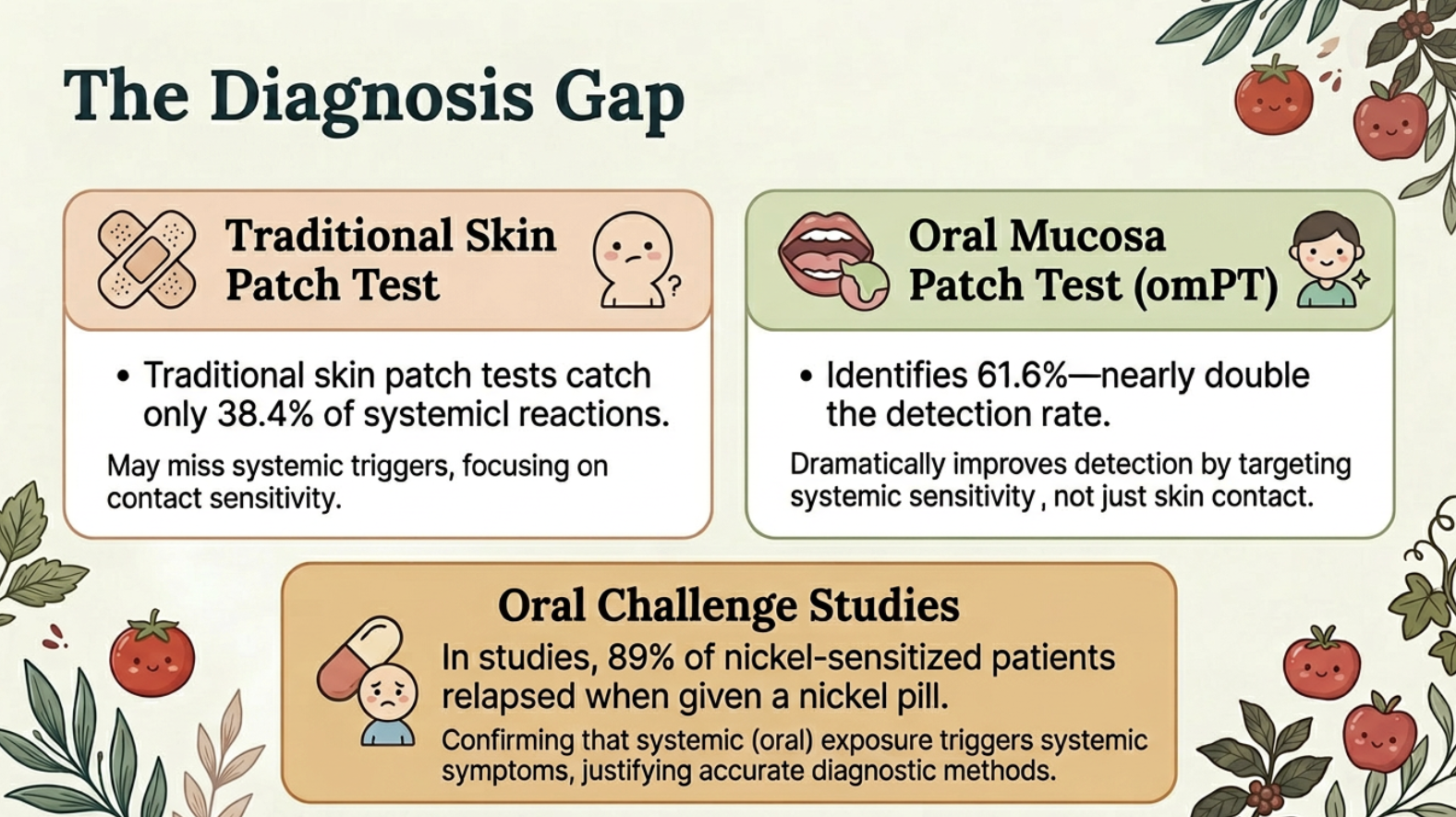
How to test for systemic nickel allergy . . . the options aren’t great.
Here's one of the most frustrating parts: the standard skin patch test catches only about 38.4% of systemic nickel reactions. The Oral Mucosa Patch Test (omPT), which places a small amount of nickel on the inner lip, identifies 61.6% — nearly double the detection rate (Picarelli et al., 2010).
Even more telling: in double-blind, placebo-controlled oral challenge studies, 89% of nickel-sensitized patients who had successfully cleared their symptoms on a low nickel diet experienced a severe relapse when given an oral nickel capsule.
So if your patch test came back negative but you still react to high-nickel foods — the test may have failed you. Not the other way around.
The "Immediate" Paradox: Why You React in Minutes
Your doctor might tell you that nickel allergy is a "delayed" reaction — 48 to 72 hours. So why do you get stomach cramps or itching 30 minutes after eating oatmeal?
Because nickel is also a "non-immunological mast cell discharger." It directly forces mast cells to dump histamine immediately, bypassing the delayed T-cell pathway entirely (Palenca et al., 2026). You can experience both an immediate histamine reaction AND a delayed immune response — a double hit from the same food.
You're not imagining it. The science backs you up.
The "Healthy Diet" Paradox
This is the part that makes my patients cry. They've been doing everything "right" — eating whole grains, loading up on greens, cutting processed food. And they keep getting sicker.
Here's why: plants naturally absorb nickel from the soil. The foods highest in nickel are the ones we're told are the healthiest — whole wheat, oats, legumes, spinach, soy, nuts, and chocolate (Bergman et al., 2016). For someone with SNAS, a "healthy" plant-forward diet can rapidly overflow their immune threshold.
It's not your fault. The dietary advice you received just didn't account for this allergy.
Your Next Step
If this sounds like you, the most important thing you can do right now is learn which foods are high and low in nickel. I've put together a free Nickel Food List that breaks it all down — download it below.
Download the Free Nickel Food List →
And if you want to understand what to DO about systemic nickel allergy, the next post in this series covers exactly how the low nickel diet works — including the threshold system that makes it manageable.
References
Ahlström MG, Thyssen JP, Wennervaldt M, Menné T, Johansen JD. Nickel allergy and allergic contact dermatitis: A clinical review of immunology, epidemiology, exposure, and treatment. Contact Dermatitis. 2019;81(4):227-241.
Bergman D, Goldenberg A, Rundle C, Jacob SE. Low Nickel Diet: A Patient-Centered Review. J Clin Exp Dermatol Res. 2016;7(355):2.
Borghini R, Porpora MG, Casale R, Marino M, et al. Irritable Bowel Syndrome-Like Disorders in Endometriosis: Prevalence of Nickel Sensitivity and Effects of a Low-Nickel Diet. An Open-Label Pilot Study. Nutrients. 2020;12(2):341.
D'Alcamo A, Mansueto P, Soresi M, et al. Contact Dermatitis Due to Nickel Allergy in Patients Suffering from Non-Celiac Wheat Sensitivity. Nutrients. 2017;9(2):103.
Di Tola M, Marino M, Amodeo R, et al. Immunological characterization of the allergic contact mucositis related to the ingestion of nickel-rich foods. Immunobiology. 2014;219(7):522-530.
Lusi EA, Di Ciommo VM, Patrissi T, Guarascio P. High Prevalence of Nickel Allergy in an Overweight Female Population: A Pilot Observational Analysis. PLOS One. 2015;10(3):e0123265.
Palenca I, Basili Franzin S, Sarnelli G, Esposito G. Palmitoylethanolamide for Nickel Allergy: Plausible, Untested, and Worth Considering. Biomedicines. 2026;14(1):177.
Picarelli A, Di Tola M, Vallecoccia A, et al. Oral Mucosa Patch Test: A New Tool to Recognize and Study the Adverse Effects of Dietary Nickel Exposure. Biol Trace Elem Res. 2010;139(2):151-159.
Ricciardi L, Arena A, Arena E, et al. Systemic nickel allergy syndrome: epidemiological data from four Italian allergy units. Int J Immunopathol Pharmacol. 2014;27(1):131-136.
Rizzi A, Nucera E, Laterza L, et al. Irritable Bowel Syndrome and Nickel Allergy: What Is the Role of the Low Nickel Diet? J Neurogastroenterol Motil. 2017;23(1):101-108.
Stanghellini V, Tosetti C, Benedetto E, et al. Nickel sensitization in patients with gastro-esophageal reflux disease. United European Gastroenterol J. 2016;4(2):184-190.
Sunderman FW Jr, Hopfer SM, Sweeney KR, et al. Nickel Absorption and Kinetics in Human Volunteers. Proc Soc Exp Biol Med. 1989;191(1):5-11.