GERD and Systemic Nickel Allergy: Why Your Reflux Won't Go Away
GERD and Systemic Nickel Allergy: Why Your Reflux Won't Go Away
If you've been taking proton pump inhibitors for your acid reflux and still suffering — or if you've been on PPIs for years with no end in sight — something is being missed.
Up to 40% of GERD patients don't respond to standard or even double-dose PPIs (Stanghellini et al., 2016). And research suggests that for many of them, the problem isn't too much acid. It's an allergy.
The Hidden Allergy Behind Your Reflux
In a major multicenter study, 39.5% of GERD patients tested positive for nickel allergy — compared to just 16.4% of people without GERD (Stanghellini et al., 2016). Another study found even higher rates: 48 out of 70 GERD patients were nickel-sensitized (Aslan et al., 2017).
That's not a coincidence. Nearly 4 in 10 reflux patients who don't get better on PPIs have a nickel allergy. And 90.4% of the nickel-sensitive GERD group were women (Stanghellini et al., 2016).
How Nickel Causes Reflux
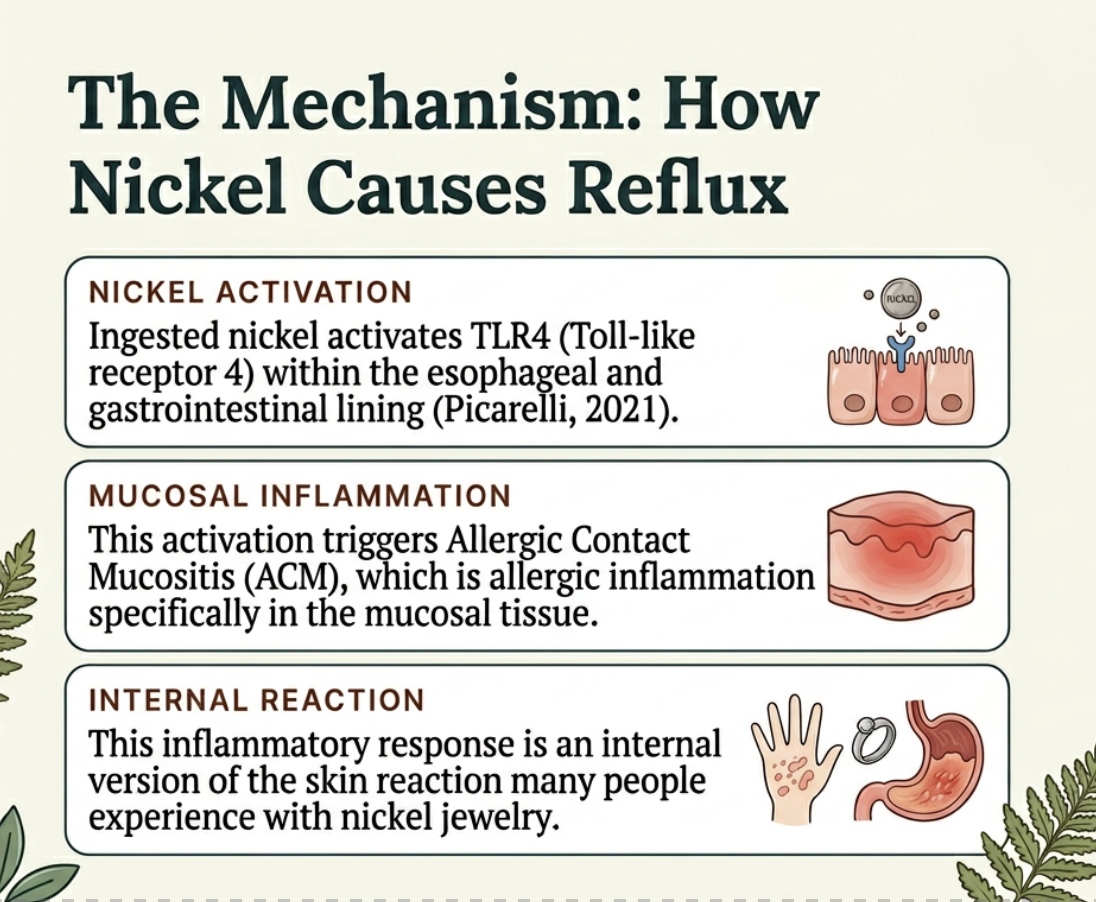
Nickel triggers inflammation in the esophagus, causing GERD
When a nickel-sensitive person eats nickel-containing food, the metal activates TLR4 immune sensors in the esophageal and GI lining, triggering Allergic Contact Mucositis — allergic inflammation in the mucosal tissue (Picarelli, 2021; Borghini, 2020).
This inflammation makes the esophagus hypersensitive. Normal amounts of acid now feel like burning because the tissue is already irritated from the inside (Stanghellini, 2016).
It's not that you have too much acid. It's that your esophagus is inflamed from an allergic reaction, and normal digestion now registers as pain.
The Trigger Food Overlap Nobody Mentions
Classic GERD advice tells you to avoid chocolate, tomatoes, and citrus. What nobody points out is that all of these foods are also very high in nickel. Patients may be reacting to the metal content, not just the acidity or fat (Stanghellini, 2016).
And here's the trap: the "safe" bland foods you replaced them with — like oatmeal and whole wheat bread — are also loaded with nickel. The trigger never left your plate.
86% Improved — Without Changing Medication
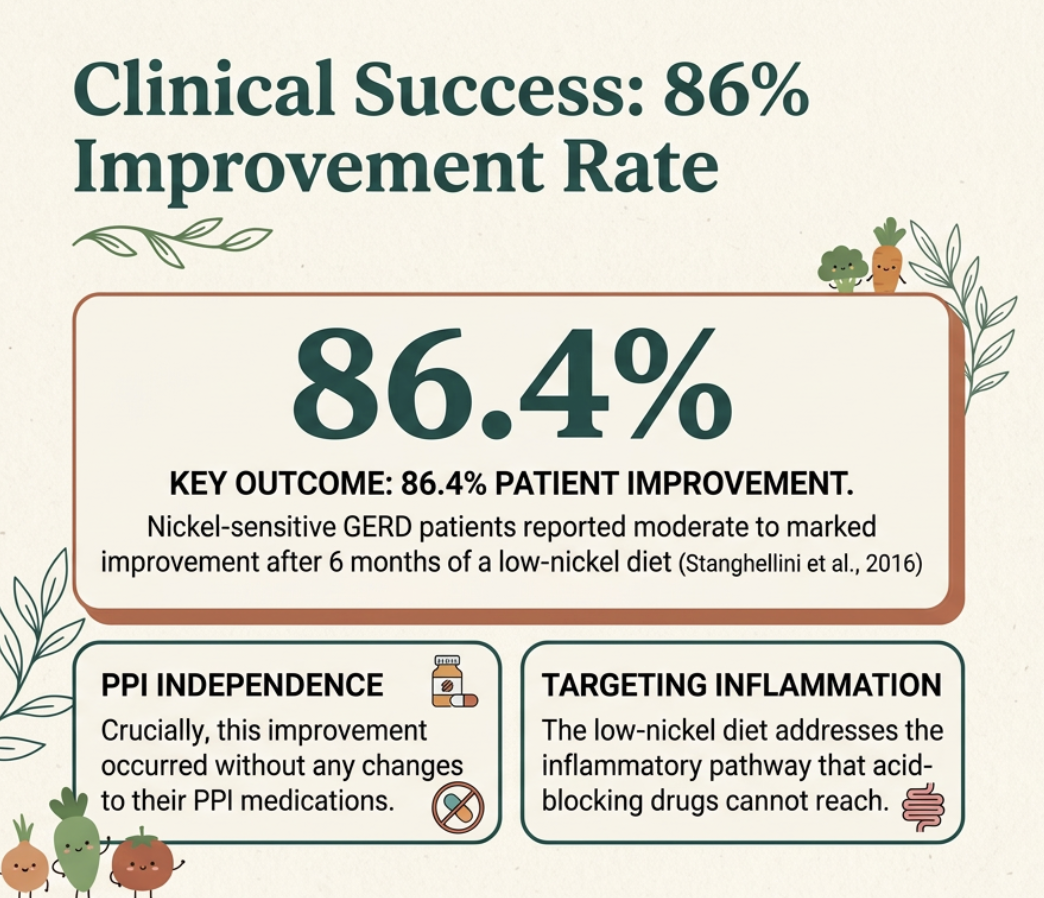
An incredible 86.4% of patients improved GERD on a low nickel diet!
After six months of dietary changes, 86.4% of nickel-sensitive GERD patients reported moderate to marked symptom improvement (Stanghellini et al., 2016).
The remarkable part: this improvement happened without any change in PPI medication. The diet addressed an inflammatory pathway that acid-blocking drugs simply cannot reach.
PPIs suppress acid. They don't stop allergic inflammation. If nickel is the driver, you need to remove the trigger — not just mask the symptom.
It's Not Just Reflux — It's Systemic
Nickel-sensitive GERD patients in the study had significantly higher rates of asthma (18.1% vs. 4.7% in non-sensitive patients) and postprandial itching — itching after meals (Stanghellini et al., 2016).
If your reflux comes with asthma, itching after eating, fatigue, or skin issues — that pattern suggests Systemic Nickel Allergy Syndrome, not isolated reflux.
The Mast Cell Connection
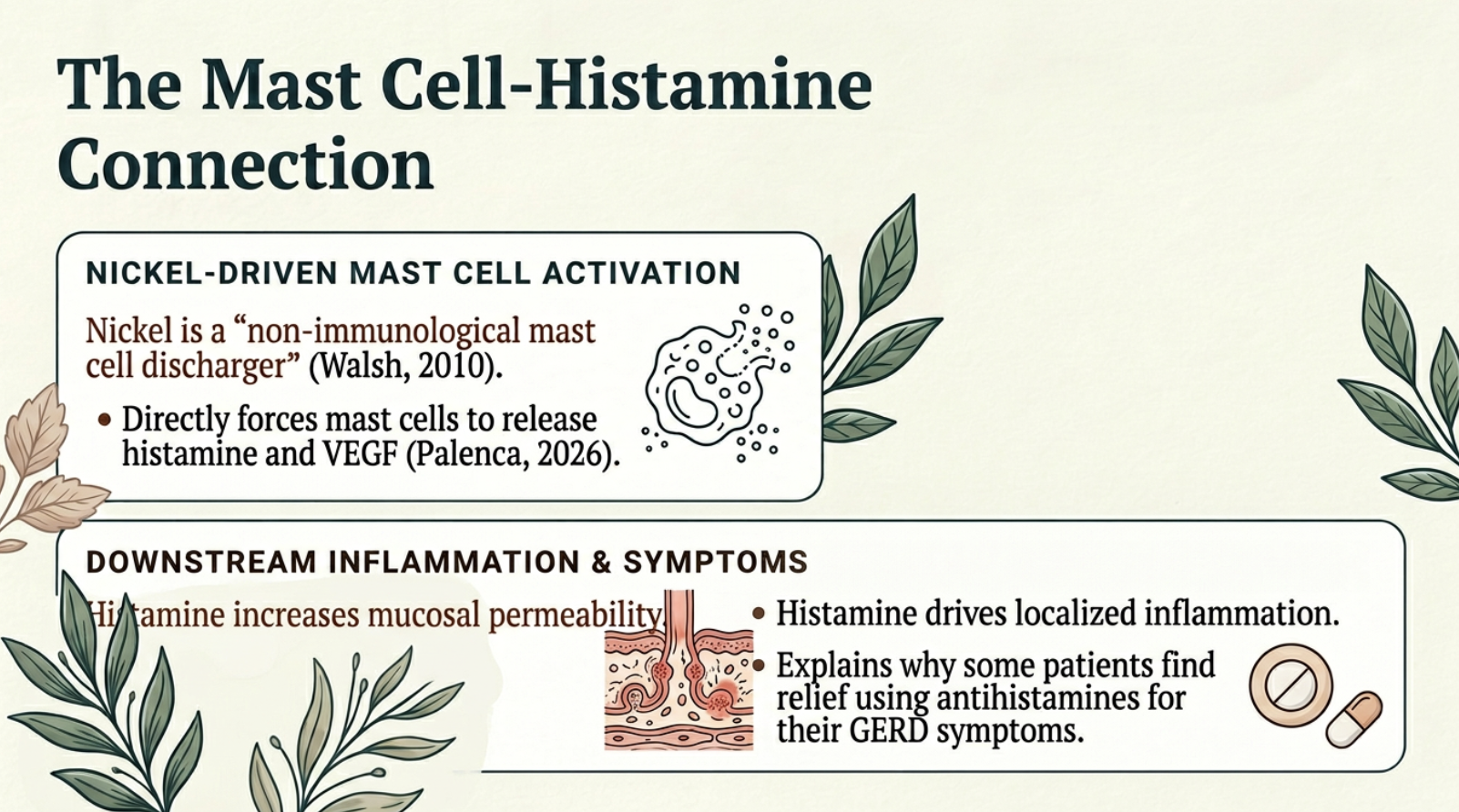
Nickel directly triggers mast cells in the esophagus to release tryptase and histamine, causing GERD
Nickel is a "non-immunological mast cell discharger" — it directly forces mast cells to release histamine and pro-inflammatory factors (Walsh, 2010; Palenca, 2026). This histamine release drives inflammation and increases mucosal permeability.
This explains why some reflux patients accidentally find that antihistamines help their stomach more than expected. The nickel is forcing histamine release, and that histamine is part of what's burning your esophagus.
Your Next Step
If you have persistent GERD that isn't responding to PPIs — especially if you also have skin issues, fatigue, or itching after meals — it's worth exploring whether nickel is the trigger.
Start by downloading my free Nickel Food List to see which "safe" foods in your current diet may actually be high in nickel.
Download the Free Nickel Food List →
Next in the series: why the blisters on your hands might be coming from your plate — the dyshidrotic eczema and nickel connection.
References
Aslan N, Sezikli M, Erdal E. Nickel sensitivity in patients with gastroesophageal reflux disease. Cutan Ocul Toxicol. 2017;36:347-350.
Borghini R, Porpora MG, Casale R, et al. Irritable Bowel Syndrome-Like Disorders in Endometriosis: Prevalence of Nickel Sensitivity and Effects of a Low-Nickel Diet. An Open-Label Pilot Study. Nutrients. 2020;12(2):341.
Palenca I, Basili Franzin S, Sarnelli G, Esposito G. Palmitoylethanolamide for Nickel Allergy: Plausible, Untested, and Worth Considering. Biomedicines. 2026;14(1):177.
Picarelli A, Greco N, Sciuttini F, Marini C, Meacci A. High consumption of Nickel-containing foods and IBS-like disorders: late events in a gluten-free diet. Ecotoxicol Environ Saf. 2021;222:112492.
Pizzutelli S. Systemic nickel hypersensitivity and diet: myth or reality? Eur Ann Allergy Clin Immunol. 2011;43(1):5-18.
Stanghellini V, Tosetti C, Benedetto E, et al. Nickel sensitization in patients with gastro-esophageal reflux disease. United European Gastroenterol J. 2016;4(2):184-190.
Walsh ML, Smith VH, King CM. Type 1 and type IV hypersensitivity to nickel. Australas J Dermatol. 2010;51(4):285-286.
Zirwas MJ, Molenda MA. Dietary Nickel as a Cause of Systemic Contact Dermatitis. J Clin Aesthet Dermatol. 2009;2(6):39-43.