Water Filtration for Systemic Nickel Allergy: The Complete Guide to Safe Hydration
You've cleaned up your diet. You've cut the whole grains, the legumes, the nuts. But you're still flaring — and nobody's talked to you about your water.
Nickel enters your home through geological leaching AND your own plumbing. Nickel-plated faucets, valves, and fittings leach ions into stagnant water — especially overnight. And the EPA limit of 0.1 mg/L was set for general population toxicity, not for the trace-level sensitivity of SNAS patients.
Even small contributions from water can push you over your individual symptom threshold.
How Nickel Gets Into Your Water
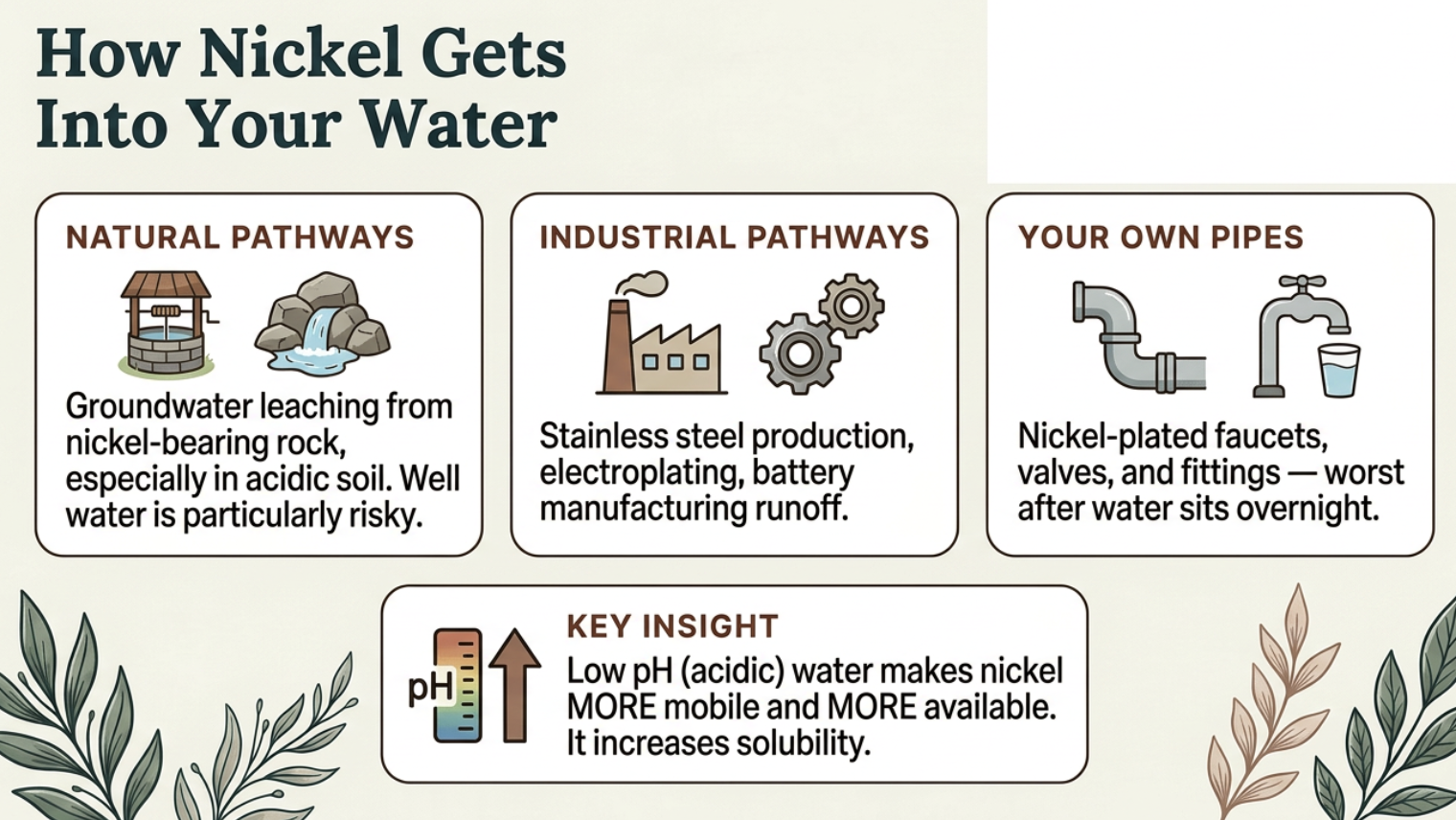
Nickel reaches your glass through three main pathways.
How nickel gets into your water
**Natural sources:** Groundwater leaching from nickel-bearing rock, especially in areas with acidic soil. Well water in acidic-soil regions is particularly risky.
**Industrial sources:** Runoff from stainless steel production, electroplating, and battery manufacturing.
**Your own pipes:** Nickel-plated faucets, valves, and fittings in your home plumbing — worst after water sits overnight. Low pH (acidic) water makes nickel more mobile and more bioavailable.
This is why some patients feel worse in certain homes or regions, and why the morning first-draw water from your tap is the most contaminated.
Why the EPA Standard Isn't Enough for You
The EPA maximum contaminant level is 0.1 mg/L — designed to prevent acute organ toxicity in the general population. SNAS patients react to trace levels far below this threshold.
Think of it like the nickel bucket. Your daily dietary intake already fills most of the bucket (100–300 µg from food alone). Water doesn't need to contribute much to push you over your personal symptom line. It's cumulative burden, not any single glass.
What Actually Removes Nickel from Water
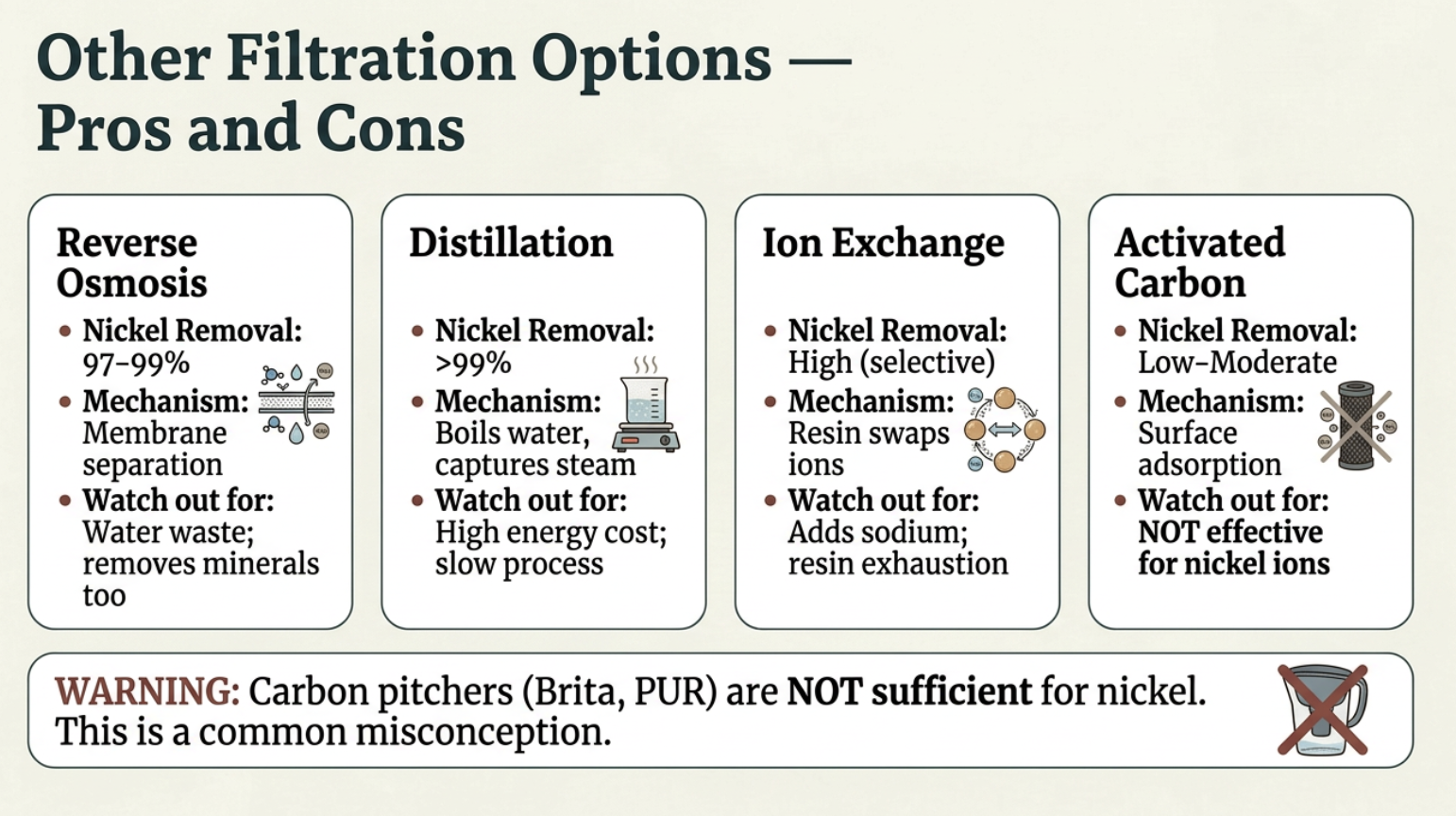
Not all filters are equal — and this is where most patients get misled. Nickel is a dissolved ion. You can't just "catch" it with a basic filter. You need technology that removes dissolved ionic species.
Filtration options for nickel removal and pros and cons
**Reverse Osmosis: 97–99% nickel removal.** This is the gold standard. Uses a semipermeable membrane to reject dissolved ions including Ni²⁺. Look for NSF/ANSI Standard 58 certification. Modern tankless systems eliminate the bacterial growth risk of storage tanks.
**Distillation: >99% removal.** Boils water, captures steam. Extremely effective but high energy cost and slow output.
**Ion Exchange: High removal (selective).** Resin swaps target ions. Effective but adds sodium and requires resin replacement.
**Activated Carbon (Brita, PUR): Low to moderate removal. NOT effective for nickel ions.** This is the single biggest misconception. Standard carbon pitchers meet NSF 42 standards for taste and odor only — they do not meaningfully remove heavy metal ions.
Recommended Filtration Systems
**Advanced pitchers (ion exchange):** Look for pitchers with ion-exchange technology or NSF 53 certification. ZeroWater (5-stage filtration) and Clearly Filtered both achieved 100% PFAS reduction in independent EWG testing, indicating robust contaminant removal.
**Countertop RO (the renter hack):** You don't need to drill a hole in your sink. Countertop RO systems simply plug into a wall outlet and sit on your counter like a coffee maker. The Waterdrop K19 and A1 are solid options.
**Under-sink RO:** The APEC ROES-50 is a budget-friendly workhorse — 5-stage RO, certified NSF/ANSI 58, with near-zero nickel in lab tests. The Waterdrop G3P800 is the premium pick — tankless design, 800 GPD flow, UV sterilization included. The iSpring RCC7AK-UVBLK is a less expensive option popular in my community.
Do You Need a Shower Filter?
Ingestion is the primary systemic trigger — shower filtration is secondary. But hot water increases skin permeability through vasodilation and stratum corneum hydration. Damaged skin (active dermatitis) absorbs significantly more nickel. And nickel in shower water can trigger localized Allergic Contact Dermatitis.
For refractory cases — patients who are still flaring despite diet changes — shower filtration is a reasonable addition.
**The critical detail:** Standard carbon filters fail in hot water. High temperatures cause contaminant desorption — meaning a carbon shower filter can actually release captured contaminants back into the water.
**KDF-55** (Kinetic Degradation Fluxion) is the standard for shower filtration. It's a high-purity copper-zinc alloy that works via redox reactions, reducing soluble nickel to insoluble metallic form. It achieves 70–90% nickel removal and works reliably in hot water. Replace cartridges every 6 months.
Most shower filters on the market use vitamin C or calcium sulfite — both excellent for chlorine removal but completely ineffective against metals.
The Remineralization Problem
Reverse osmosis removes everything — including essential minerals. Prolonged consumption of demineralized water can cause muscle cramps, fatigue, impaired neurological function, and increased corrosion of dental materials. The WHO recommends at least 20–30 ppm calcium and 10 ppm magnesium in drinking water.
**How to remineralize safely:**
An integrated remineralization cartridge (calcite or corosex as a final RO stage) is the simplest approach. Concentrated mineral drops like BodyBio ReMineralize work well for manual addition.
**But here's the critical warning:** do NOT use "natural" salts for remineralization without understanding contamination risks.
The Dirty Truth About "Healthy" Salt
Dirty Salt: Himalayan, Sea Salt, & Celtic Salt (grey salt)
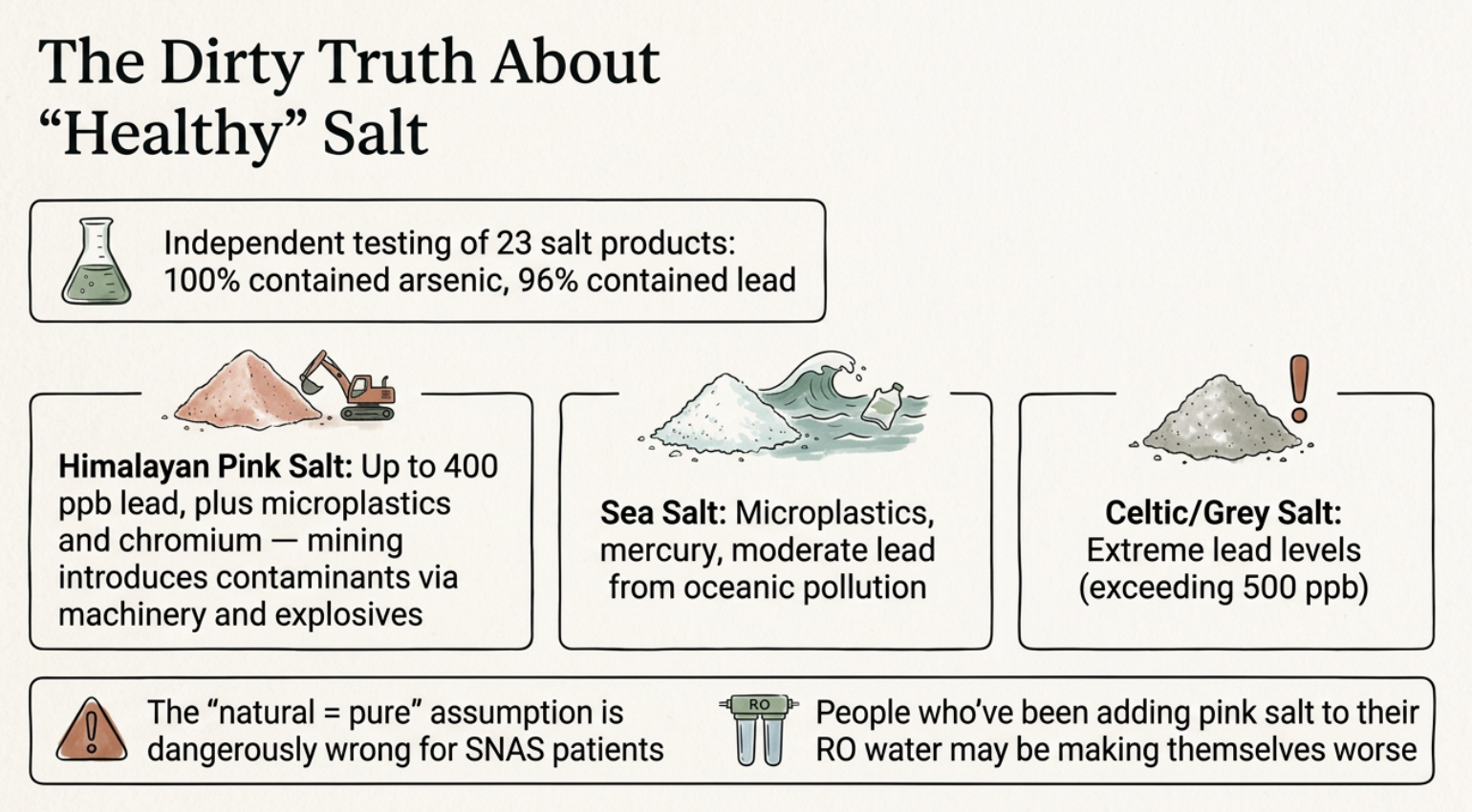
Independent testing of 23 salt products found that 100% contained arsenic and 96% contained lead. The "natural = pure" assumption is dangerously wrong for SNAS patients.
**Himalayan Pink Salt:** Up to 400 ppb lead, plus microplastics and chromium. Mining introduces contaminants via machinery and explosives.
**Sea Salt:** Microplastics, mercury, moderate lead from oceanic pollution.
**Celtic / Grey Salt:** Extreme lead levels exceeding 500 ppb.
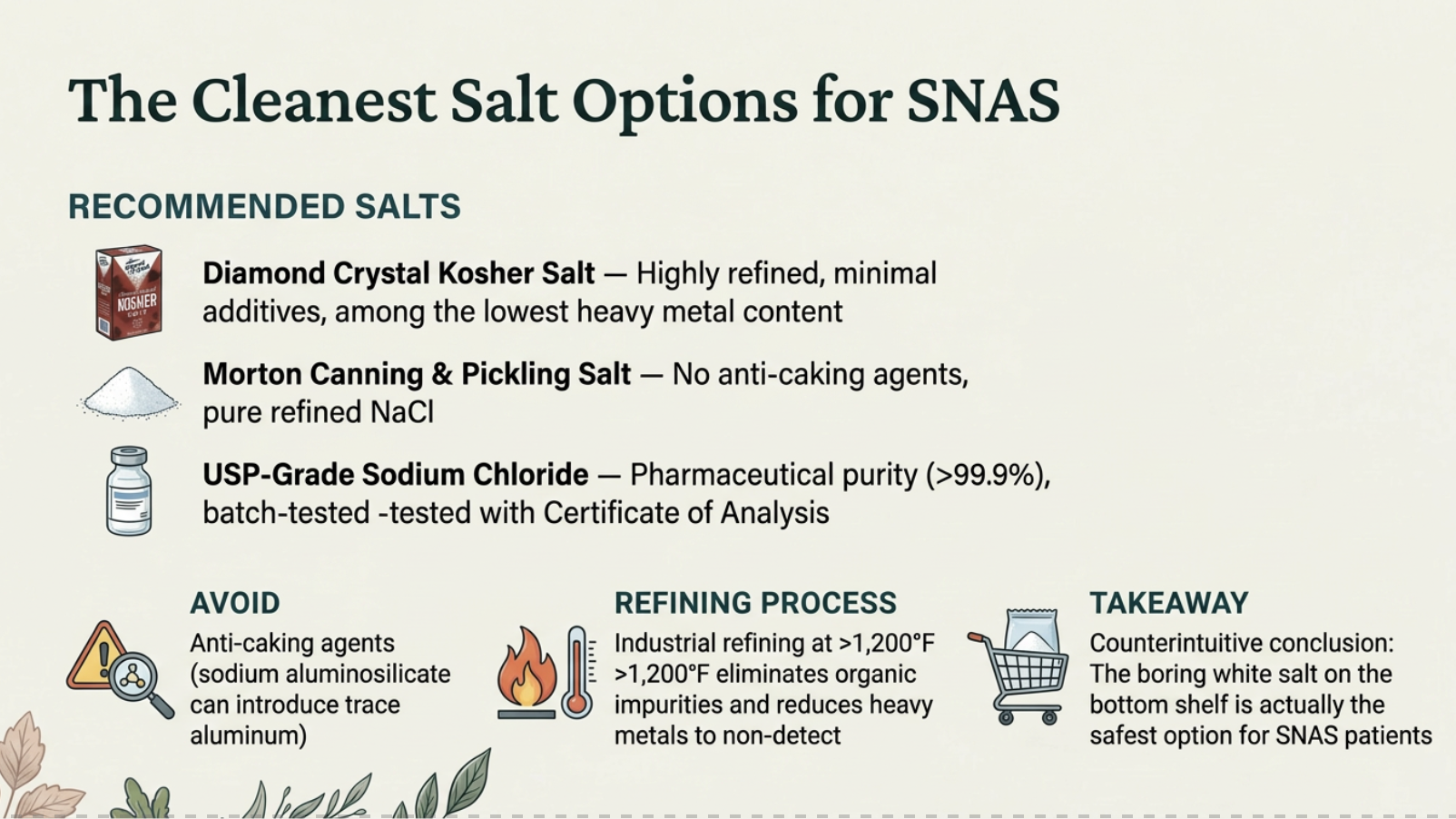
**Refined table salt:** 0–100 ppb lead. Industrial refining at over 1,200°F eliminates organic impurities and reduces heavy metals to near non-detect.
Yes — the boring white salt on the bottom shelf is the safest option for you.
**Best choices for SNAS patients:** Diamond Crystal Kosher Salt (highly refined, minimal additives), Morton Canning & Pickling Salt (no anti-caking agents, pure refined NaCl), or USP-grade sodium chloride (pharmaceutical purity >99.9%, batch-tested with Certificate of Analysis).
Cleanest salt options for systemic nickel allergy (and maybe for everyone!)
DIY Nickel-Safe Oral Rehydration Solution
When you want total control over what goes in:
- 1 liter RO or distilled water
- 2,500 mg sodium chloride (USP grade or Diamond Crystal Kosher)
- 385 mg potassium chloride (USP grade or high-quality salt substitute)
- 390 mg magnesium malate or citrate (pure powder, no fillers)
- Optional: ½ tsp baking soda to neutralize acidity
- Optional: squeeze of fresh lemon or lime (citrus is generally low nickel)
This is based on WHO oral rehydration solution principles. The quality of ingredients matters — which is why we discussed chemical grades.
Clean Electrolyte Products
If you prefer ready-made options: **Thorne Catalyte** (NSF Certified for Sport, heavy metal tested), **Nuun Sport** (Informed Choice certified), **Seeking Health** (designed for complex dietary sensitivities), and **BodyBio ReMineralize** (72+ ionic trace minerals from concentrated inland seawater).
Avoid products with botanical extracts, "natural flavors," cocoa, or nut-derived ingredients.
Your Action Plan — In Priority Order
**Priority 1: Filter your drinking water.** Install a multi-stage RO system (NSF/ANSI 58 certified). This is the single highest-impact intervention.
**Priority 2: Consider shower filtration.** KDF-55 media specifically, if you have refractory symptoms or active dermatitis.
**Priority 3: Remineralize strategically.** Use refined kosher salt or pharmaceutical-grade electrolytes. Ditch the pink salt.
**Priority 4: Monitor and test.** Dimethylglyoxime testing of fixtures, dietary tracking, urinary nickel measurement if available.
Quick Wins You Can Do This Week
- Run your tap for 30–60 seconds before filling your glass (flushes stagnant nickel)
- Check your current filter — is it actually certified for heavy metals?
- Look at your salt container — is it refined or "natural"?
- Test your faucets with a dimethylglyoxime nickel test kit
- Consider a TDS meter to understand your water baseline
Your Next Step
Water is often the last piece patients address — but for some, it's the missing piece that finally tips the bucket back below threshold. Start with filtered drinking water and clean salt, then build from there.
Go to my resources page to “kitchen tools” to find my recommended filtration products
Download the free water filtration guide here
Download my free Nickel Food List to make sure your dietary foundation is solid alongside your water strategy.
**Download the Free Nickel Food List**
---
References
Solomons NW, Viteri F, Shuler TR, Nielsen FH. Bioavailability of nickel in man: effects of foods and chemically-defined dietary constituents on the absorption of inorganic nickel. J Nutr. 1982;112(1):39-50.
Zirwas MJ, Molenda MA. Dietary Nickel as a Cause of Systemic Contact Dermatitis. J Clin Aesthet Dermatol. 2009;2(6):39-43.
Sharma AD. Low nickel diet in dermatology. Indian J Dermatol. 2013;58(3):240-247.
Mislankar M, Zirwas MJ. Low-nickel diet scoring system for systemic nickel allergy. Dermatitis. 2013;24(4):190-195.
IARC Working Group. Nickel and Nickel Compounds. In: Arsenic, Metals, Fibres and Dusts. IARC Monographs on the Evaluation of Carcinogenic Risks to Humans, Vol. 100C. Lyon, France: IARC; 2012.
US Environmental Protection Agency. Nickel Compounds. EPA Technical Factsheet. 2016.
European Food Safety Authority. Update of the risk assessment of nickel in food and drinking water. EFSA J. 2020;18(11):e06268.